Whoever invented slab pies deserves a kiss on the mouth.
Slab pie is an easy, genius pie that serves a crowd with less fuss and less mess. And whether you like the chocolaty creaminess of French Silk, the double-duty flavors of Pumpkin-Pecan or the classic fruity-freshness of our Blueberry Slab Pie, there’s always a good reason to go with a slab over a slice.
Generally speaking, slab pies usually serve 16 people, so no one is going to go hungry with one of these sitting on the dessert table. Most slab pies are delicious beyond measure because they are very crust-forward—and we all know the crust is the best part of a pie.
No pie pan? No problem. Another beautiful thing about a slab pie is that it’s made in a 15x10x1-inch jelly roll pan, which is a little smaller than a typical baking sheet and has a 1-inch lip. They are easy to find and more versatile than a pie pan since they can be used to roast vegetables or bake sheet cakes as well—in fact, you might already have one in your cupboard and not even know it.
But the real question is: “What if I have a beloved standard pie recipe that I want to transform into a slab pie to serve a crowd?” Glad you asked! We consulted our Pillsbury Kitchens experts to weigh in on everything you need to consider before you experiment in your own kitchen.
To dive deeper into the topic of pies (one of our favorite things to talk about), we asked our team in the Pillsbury Kitchens how to easily convert our favorite 9-inch round pies into rectangular, slab-style pies baked in a sheet pan. And while we came out of our discussions with three delicious new classic slab pie recipes—Pumpkin Slab Pie, Apple Slab Pie and Pecan Slab Pie—we also learned that our question could not be answered with a simple formula.
To convert a standard pie to a slab pie, there are several factors to consider, including: the pie crust, the filling and the bake temperatures and times. Let’s cover all three in more detail!
Let’s do some simple math: The general rule is to double the amount of crust you’d need for a 9-inch round standard-size pie to fill a 15x10x1-inch slab pie. For example, if you need one box (14.1 oz) Pillsbury™ refrigerated pie crust for a standard double-crust pie, you’ll need two boxes, or four pie crusts, to make a double-crust slab pie.
For all of our slab pies that use Pillsbury™ refrigerated pie crust, we use two crusts for the base and two crusts for the top crust (for double-crust pies). To prep for a slab pie, remove pie crusts from pouches; on lightly floured surface, unroll and stack crusts on top of the other. Roll to 17x12-inch rectangle (or 18x12-inch, if you have a slightly deeper sheet pan or want a little more wiggle room for fluting the edges). Fit the bottom crust into an ungreased 15x10x1-inch pan, pressing into corners.
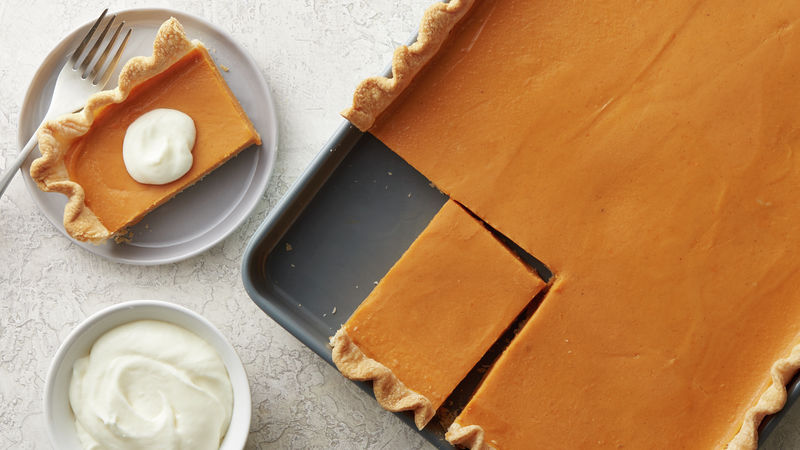
In testing our slab-style pies, we discovered that in order to make sure the bottom crusts of some of our more liquid-based/custard-based filled pies—such as our Pumpkin Slab Pie and Pecan Slab Pie—the bottom crust must be par-baked, or pre-baked until just browned and set. Pies like pumpkin and pecan have a liquid filling that tends to be higher in fat, which often hinders the full baking of a bottom crust. There are other factors at play when baking a sheet-pan pie, too, that can alter the typical outcome of a pie crust, including the fact that the bake time is often lower to accommodate the shorter height of filling.
In short, when baking a slab pie with a liquid or custard filling, it is best to par-bake the pie crust at a high temperature (usually 425°F for Pillsbury™ refrigerated pie crust) for 6 to 7 minutes (no pricking with a fork needed) before adding the filling. If the crust puffs up during baking, press it down lightly with the back of a flat metal measuring cup.
Expert tip: Don’t forget to adjust the oven temperature for the filling after pre-baking the crust! Many recipes call for two different temperatures for these steps.
However, this is not the case when it comes to fruit-filled pies (such as our Apple Slab Pie) or pies with no-bake fillings (such as our French Silk Slab Pie). For fruit-filled slab pies, we found that the bottom crust bakes through perfectly without a pre-bake because the filling is drier than a custard pie, allowing for better heat conduction throughout. For slab pies with no-bake fillings, just pre-bake the pie crust completely and fill as directed in the recipe.
If you’re itching to make your favorite standard pie for a crowd, there are a few tips and tricks to know when it comes to increasing the filling to fit your slab pie.
We found in testing that there is no precise formula for adjusting the amount of filling. While the general rule is to make 1 1/2 times the amount of filling you’d need for a 9-inch round standard-size pie to fill a 15x10x1-inch slab pie, it isn’t always that simple. Here’s what we learned from our Kitchens experts:
Expert tip: Don’t forget to increase the amount of topping or garnish, too (because a pie without enough whipped cream is a sad pie)!
Though the oven temperature shouldn’t change from the original recipe, bake times could vary greatly. Generally speaking, take the minimum original bake time from your standard pie recipe and reduce it by 10 minutes—that’s when you should first start to check your slab pie for doneness. For example, our Perfect Apple Pie recipe bakes at 425°F for 40 to 45 minutes; our Apple Slab Pie bakes at 425°F for 30 to 35 minutes. Continue to check your pie every 5 minutes until it appears to be fully baked.
For best results, rely heavily on visual cues. For a fully-baked custard pie, the filling should be fully set; for a fully-baked fruit pie, the fruit should be tender and the crust deep golden brown.
As you would with standard-size pies, it’s best to let your slab pie cool completely on a cooling rack (or refrigerate, depending on the recipe directions) before serving. Once it’s fully cooled or chilled, cut into squares and serve!
Before you get to baking your crowd-sized pies, we have a few more tips for you to ensure ultimate slab pie-baking success:
We encourage you to experiment in the kitchen with converting your favorite pie to a slab pie. However, if you want to give one of our already tried-and-true, Kitchen-tested slab pies a try this season, we fully support you. Above all, have fun: The end result is delicious pie, after all.